
Fifty-six years ago this week, on November 3, 1970, Pitkin County voters went to the polls to decide whether Hunter S. Thompson should be their sheriff. He lost, taking about 38 percent of the vote in a three-way race. But the campaign he ran from his Woody Creek ranch changed the valley's politics for decades.
Thompson was not yet the gonzo legend of Fear and Loathing in Las Vegas. He was a 33-year-old writer with one book, Hell's Angels, and a growing following at Rolling Stone. He was also a local, and he was fed up.
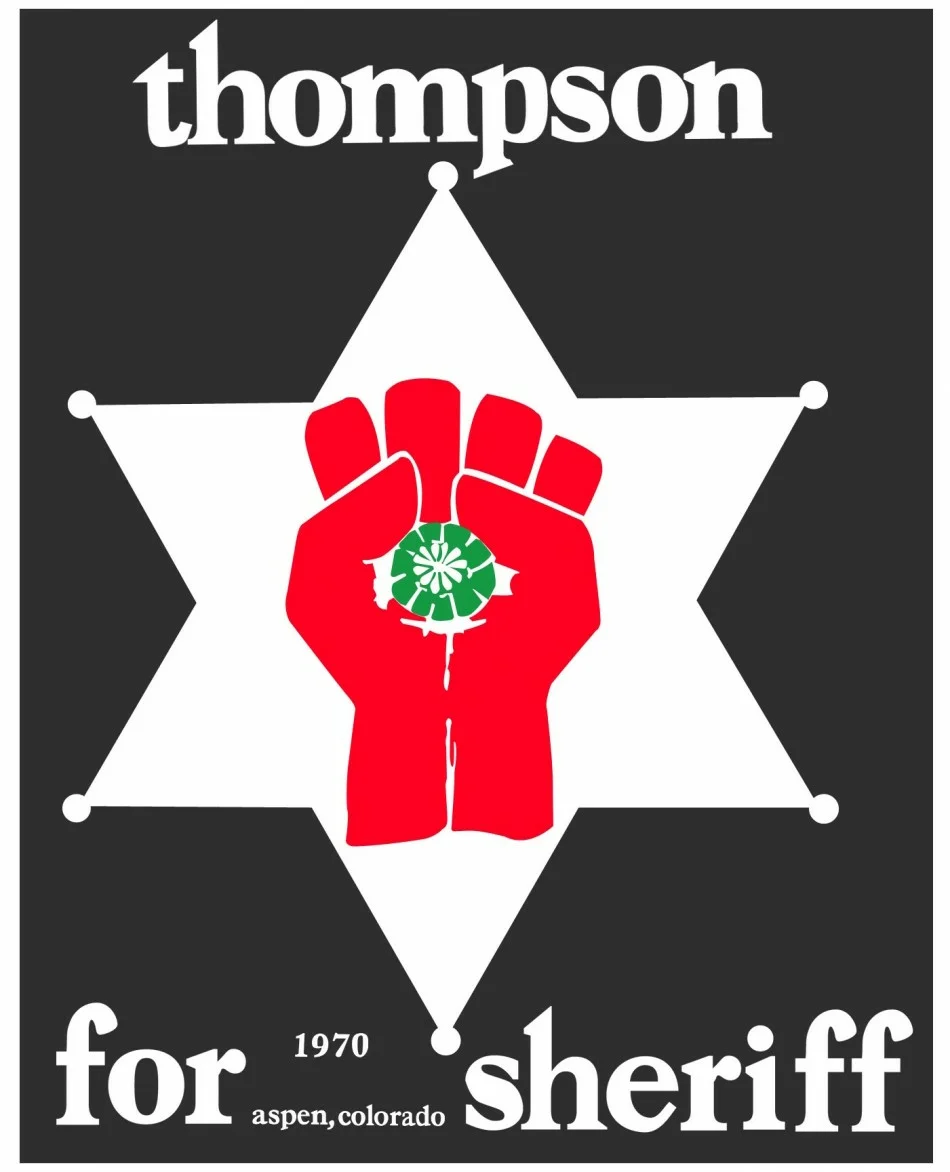
Featured image: By Illustrated and printed by Thomas W. Benton (1930–2007). Distributed in and around Aspen, Colorado by Benton, Thompson, and other "Freaks". - Scan via groundfloormedia.com. An original copy once owned by Thompson can be compared at tomwbenton.com, with further information about Benton and Thompson's early relationship., Public Domain, https://commons.wikimedia.org/w/index.php?curid=93124666
A town at a crossroads
By the late 1960s, Aspen was caught between two worlds. Old-guard locals and business interests ran the town. Meanwhile, ski bums, artists and hippies kept arriving, and developers saw a gold mine in the mountains.
The Freak Power movement started a year before Thompson's own run. In 1969, he helped organize the mayoral campaign of Joe Edwards, a 29-year-old lawyer who had defended local hippies. Their strategy was simple: register the long-haired newcomers who had never bothered to vote. Edwards lost by just six votes after the Democrats and Republicans lined up behind a single opponent.
The near-miss proved the idea could work. As part of their deal, Thompson agreed to take on the sheriff's race in 1970, alongside Freak Power candidates for county commissioner and coroner. He told the story of the Edwards race in an October 1970 Rolling Stone piece, "The Battle of Aspen," which introduced the Freak Power philosophy to a national audience.
A platform that was half joke, half blueprint
Thompson's platform is mostly remembered for its outrageous parts. He promised to rip up Aspen's paved streets and replace them with sod, and to push for renaming the town "Fat City" so that investors and speculators would lose interest in it.
Under the theatre was a serious agenda, much of it ahead of its time:
Stopping runaway development. He vowed to go after the "greedheads" and land developers he believed were wrecking the valley.
Treating environmental damage as a crime. Polluters and land rapers, as he called them, would face prosecution.
Changing drug enforcement. He wanted to stop arresting people for personal drug use and focus on dealers who cheated their customers.
A less heavily armed sheriff's office. He wanted deputies to go unarmed in public to lower tension between police and residents.
As he put it in campaign material, "There is common sense in the apparent madness of my campaign."
The campaign trail, Aspen style
The incumbent was Sheriff Carrol D. Whitmire, a Democrat who dismissed the "freaks" and said he didn't know what Freak Power even meant. Thompson embraced the label.
The campaign's best-remembered stunt came before a debate: Thompson shaved his head completely bald. That let him refer to the short-haired Whitmire as "my long-haired opponent." Young Aspenites packed the Isis Theatre to watch the two men face off.
The campaign also had a striking look. Aspen artist Thomas W. Benton designed its posters, including the double-thumbed fist that became the Freak Power logo. That fist later became the symbol of gonzo journalism and of Thompson himself.
It wasn't all fun. As national media arrived to cover the race, tensions rose. Supporters later described threats against Thompson and real fear of violence at his Woody Creek home, Owl Farm.
Election night at the Hotel Jerome
Freak Power headquarters for election night was the Hotel Jerome. Supporters, some in costume, gathered expecting to make history.
The establishment had other plans. Ahead of the vote, local party leaders held an emergency meeting and agreed to consolidate behind Whitmire. The Republican candidate was effectively abandoned so the anti-Thompson vote wouldn't split. Thompson did well in Aspen itself, but returns from the rural parts of the county sank him that evening.
Whitmire won by roughly 500 votes. Thompson gave his concession speech to a crowd of reporters, and the Freak Power dream was over, at least for the moment.
Lost the battle, won the war
Thompson never held office. But the people he brought into politics did.
One campaign volunteer was Bob Braudis, whose job was registering his ski-bum friends to vote. Braudis went on to serve as Pitkin County sheriff from 1986 to 2010, winning re-election five times. He ran the department in a way that reflected much of what Thompson had argued for, and he called Thompson his "North Star." Joe Edwards, the 1969 mayoral candidate, later became a county commissioner. Many locals trace Pitkin County's tough stance on growth and its strong environmental protections back to that era.
Thompson stayed in Woody Creek for the rest of his life. When he died in 2005, his ashes were fired from a cannon at Owl Farm in a send-off that was very much his style.
Explore the story yourself
Read the book. Aspen's Daniel Joseph Watkins collected campaign posters, articles and photos in Freak Power: Hunter S. Thompson's Campaign for Sheriff (2015).
Watch the documentary. Freak Power: The Ballot or the Bomb (2020), co-directed by Watkins and Ajax Phillips, uses original footage shot during the campaign.
Visit the places. Have a drink at the Hotel Jerome, where the election-night party happened, or stop by Woody Creek, Thompson's longtime home turf. Owl Farm itself is private property.
Featured Image: By Published by the Thompson campaign, printed by Thompson's associate Thomas W. Benton. Photographer uncredited; likely David Hiser, who took other photos for the campaign. - *Original source: Published on the backside of "Aspen Wall Poster No. 5", a Thompson campaign poster distributed in and around Aspen circa October 1970.Immediate source: Scan via Freak Power page at Facebook. Cropped to include just the photo and retouched by uploader; see upload history below for unretouched original., Public Domain, https://commons.wikimedia.org/w/index.php?curid=93177170